




Best Privacy Hedges for South Florida: Clusia, Podocarpus, Areca & Cocoplum Compared
Four plants dominate privacy hedges in Palm Beach, Broward, and Miami-Dade: clusia, podocarpus, areca palm, and red tip cocoplum. We grow and deliver all four, and our order data shows what actually gets planted: clusia outsells the rest combined. But the runner-ups exist for good reasons — each wins in situations where clusia isn't the right call. Here's the honest comparison.


Quick comparison
| Clusia | Podocarpus | Areca Palm | Cocoplum | |
|---|---|---|---|---|
| Botanical name | Clusia guttifera | Podocarpus macrophyllus | Dypsis lutescens | Chrysobalanus icaco |
| Growth speed | Fast | Moderate | Fast | Moderate |
| Typical hedge height | 4–8 ft (to 20+ untrimmed) | 4–8 ft (to 25+ untrimmed) | 12–20 ft | 3–6 ft (to 12 untrimmed) |
| Spacing (by pot size) | 1.5–4 ft centers | 1–2.5 ft centers | 3–5 ft centers | 1.5–3 ft centers |
| Minimum width | ~3 ft | ~2 ft — narrowest | 6+ ft | ~3 ft |
| Salt tolerance | Excellent | Good | Moderate | Excellent (native) |
| Drought tolerance (established) | Excellent | Excellent | Low — wants irrigation | Good |
| Shade tolerance | Partial | Good — best of the four | Partial | Partial |
| Look | Thick, glossy, modern | Fine-needled, formal | Soft, feathery, tropical | Red new growth, natural |
| USDA zones | 10–11 | 9–11 | 10–11 | 10–11 |
Clusia: the default choice, for good reason
Clusia is what most of our customers pick, and the data backs the instinct: fast establishment, thick paddle-shaped leaves that block sightlines completely, excellent salt and drought tolerance, and almost no pest problems. If you have full sun, at least 3 feet of width, and want privacy quickly, clusia is the safe answer. Its weaknesses: it won't stay dense in real shade, and in a very narrow side yard it wants more width than podocarpus.
Shop Clusia → · Torn between the top two? See our head-to-head Clusia vs Podocarpus comparison.
Podocarpus: the formal, narrow-space specialist
Podocarpus grows slower but rewards patience with the cleanest, most formal hedge of the four — a fine-textured green wall you can shear like a hedge in a European garden. It's the only one that thrives clipped to 2 feet wide, which makes it the pick for zero-lot-line homes, courtyards, and driveway borders. It also handles shade and light frost better than the others (zones 9–11), so it's the safer choice inland and under partial canopy.
Areca palm: soft, tall, tropical — with a thirst
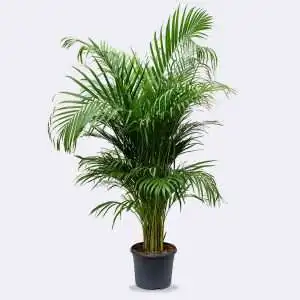
An areca screen doesn't read as a "hedge" at all — it's a wall of feathery palm fronds, and it gets tall: 12–20 feet, far above what clusia or cocoplum are usually maintained at. That makes arecas the answer for second-story privacy (blocking a neighbor's balcony view) and for softening pool cages. The trade-offs are real: arecas want consistent irrigation and regular palm fertilizer to stay green in sandy soil, and a mature clump needs 6+ feet of width.
Red tip cocoplum: the native with the coastal edge
Cocoplum is the Florida native of the group, and near the beach or Intracoastal that matters — it shrugs off salt spray and coastal wind that stress other hedges. Its red new growth gives a hedge two-tone color no one else offers, and native-plant landscaping requirements (increasingly common in South Florida communities) are satisfied by it. It's usually kept lower — 3 to 6 feet — so it suits front-yard definition more than tall backyard screening.
Which hedge should you pick?
- Fast privacy, full sun, standard yard: clusia.
- Narrow side yard or formal look: podocarpus.
- Height above a fence line or pool cage: areca palm.
- Beachside, canal-front, or native requirement: cocoplum.
- Shade under mature oaks: podocarpus first, or consider viburnum suspensum.
How many plants will you need?
Measure your fence or property line, then use our hedge plant spacing calculator — it converts footage, plant choice, and container size into an exact count. Spacing depends on the size you buy: for example, 7-gallon clusia goes on 2-ft centers while 15-gallon goes on 3-ft centers. The same calculator also appears right on the clusia, podocarpus, cocoplum, and Green Island product pages above the Add-to-Cart button.